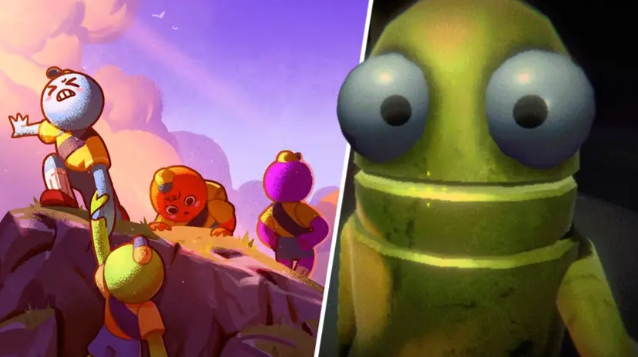
Co-op Chaos
What is Friend Slop? and Why You Should Play It.
By Ocellus · March 20, 2026
You’ve heard of AAA games. You’ve heard of indie gems. But you probably haven’t heard of Friend Slop. That’s okay. Most of us didn’t know we were playing it either.
Friend Slop: Why the Worst Games Make the Best Memories
Friend Slop is the collection of chaotic, low-stakes, often janky games you play with your friends—not because they’re polished or critically acclaimed, but because they’re fun together.
It’s the random free game someone found at 1am and dropped into the group chat with zero explanation. It’s the broken physics that sends your character flying across the map for no reason. It’s the yelling in voice chat when everything inevitably falls apart.
Alone, these games might be a 4/10. With friends, they’re a 10/10. That gap—that absurd jump in enjoyment—is what makes Friend Slop so special.
What Counts as Friend Slop?
Friend Slop isn’t really a genre. It’s not defined by mechanics, graphics, or even quality. It’s defined by context—specifically, who you’re playing with.
Still, there are some common patterns.
It might be that one co-op horror game where nothing works properly. The monster bugs out halfway through a chase, doors don’t open when they should, and someone clips through a wall and can’t get back. Instead of ruining the experience, those moments become the highlight.
It could be a party game where the controls make no sense. Nobody fully understands what’s happening, but everyone is yelling instructions anyway. Half the time you’re pressing buttons at random and hoping something works.
Sometimes it’s just a cheap or free multiplayer game with scuffed mechanics. Movement feels off, animations look strange, and the UI seems like an afterthought. Or it’s an old game you revisit purely for nostalgia, only to realize it’s way jankier than you remember.
That’s the space Friend Slop lives in—where polish doesn’t matter, expectations are low, and chaos fills the gaps.
Why “Bad” Games Become Great with Friends
On paper, most Friend Slop games aren’t very good. They’re buggy, unrefined, and sometimes barely functional. So why do they end up being some of the most memorable gaming experiences you can have?
Because the game stops being the main event.
When you’re playing alone, the game has to carry everything: mechanics, progression, challenge, and engagement. If those things aren’t solid, the experience falls apart quickly.
With friends, the game becomes more of a backdrop. It’s a shared space where things happen, and those things don’t need to be well-designed to be fun—they just need to be unpredictable.
In fact, unpredictability is the point.
A perfectly balanced, highly polished game is designed to minimize frustration and maximize fairness. That’s great for competitive play, but it often removes the kinds of ridiculous, unscripted moments that people actually remember.
Friend Slop thrives on the opposite. It thrives on things not working quite right.
The Role of Chaos
Chaos is the core ingredient of Friend Slop.
When a game behaves exactly as expected, there’s less to react to and less to laugh about. But when something breaks—when physics glitches out, when the AI does something completely unhinged, or when a mechanic doesn’t work the way anyone thought it would—that’s when the fun starts.
Think about the moments you actually remember from playing games with friends. It’s rarely the time everything worked perfectly. It’s the time something went completely off the rails.
Someone gets launched into the sky. Someone accidentally sabotages the entire team. Someone makes a terrible decision at the worst possible moment.
These moments aren’t carefully designed. They’re accidents. And Friend Slop is basically a factory for those accidents.
Low Stakes, High Fun
Another reason Friend Slop works so well is that there’s no pressure.
You’re not grinding ranks or optimizing builds. You’re not worrying about the meta or trying to improve your performance. You’re just playing.
That lack of pressure changes everything. In more competitive games, mistakes can feel frustrating, and losing can feel like wasted time. There’s often an expectation that you should be getting better.
Friend Slop throws that expectation out completely.
You don’t have to be good. You don’t even have to understand what’s happening. And because of that, people are more willing to experiment, mess around, and take risks.
Ironically, that often leads to more fun than games that are objectively better.
Easy to Jump Into
Friend Slop games are also easy to jump into—not because they’re perfectly designed, but because nobody cares if you’re good at them.
You can join halfway through a session, play for 20 minutes or three hours, leave, come back, and nothing really changes. There’s no real commitment.
That makes them perfect for spontaneous gaming. Someone suggests a random game, a few people download it, and within minutes you’re all in a lobby trying to figure things out together.
There’s something refreshing about that. No preparation, no expectations—just immediate, shared chaos.
Inside Jokes and Shared Moments
One of the most underrated parts of Friend Slop is how quickly it creates inside jokes.
Because the experiences are so unpredictable, they naturally lead to moments that only your group understands. A weird bug becomes a running joke. A specific sound effect turns into a meme. A single chaotic round becomes a story that gets referenced for weeks.
These moments give Friend Slop its staying power. You might forget the name of the game, and you might never play it again, but you’ll remember what happened—and who you were playing with.
Turning Bad Games Into Great Nights
Friend Slop has a strange ability to turn objectively bad games into great experiences.
A game that would be boring or frustrating on your own becomes something completely different in a group setting. It becomes a platform for interaction, a catalyst for laughter, and a source of stories.
In a way, it redefines what “good” means in gaming. It’s not about polish, depth, or even longevity. It’s about whether a game can create moments.
And sometimes, the less polished a game is, the better it is at doing exactly that.
The 1AM Effect
A lot of Friend Slop sessions happen late at night, when everything feels a little funnier than it should.
At 1am, your standards are lower, your patience is higher, and your sense of humor is way more forgiving. A bug that might annoy you during the day becomes hilarious at night. A confusing mechanic becomes a shared problem instead of a personal frustration.
This “1AM effect” amplifies everything that makes Friend Slop enjoyable. It turns minor issues into major entertainment.
Stop Chasing “Perfect” Games
Modern gaming often pushes you toward optimization—best builds, best strategies, best experiences. There’s always something to chase.
Friend Slop rejects that mindset.
It suggests that the “best” game isn’t always the most polished or the highest rated. Sometimes it’s the one that gives you the funniest night with your friends.
There’s a kind of freedom in that. You don’t have to keep up with trends or invest hundreds of hours. You don’t have to take it seriously.
You just have to show up.
You’ve Probably Already Experienced It
If you’ve ever spent more time laughing than actually playing, you’ve already experienced Friend Slop.
If you’ve ever stuck with a broken or weird game longer than you should have—just because it was fun with friends—that’s exactly what this is.
It’s not rare or niche. It’s something most people have experienced without having a name for it.
Final Thought
So next time your friends mention a random cheap game you’ve never heard of, don’t overthink it.
Don’t check reviews. Don’t worry about whether it’s “worth it.”
Just give it a shot.
Worst case scenario, the game is bad. Best case scenario, it’s unforgettable.
And more often than not, those two things end up being the same.